I don't just use AI —
I engineered a pipeline around it
Router → 6 branches → mandatory Hardening → Elite Amplifiers. Process weight scales to the task's risk; gates on production branches are maximal. Solo developer, Claude Code + multi-model deliberation.
Vladimir Kharlashko · Multi-Agent AI Systems Architect · Belgrade · CET/CEST
Method — vibe-pipeline
You get predictable releases and fewer surprises. Every task is classified before any code and routed through automated quality gates — bugs caught before production, speed matched to the task's risk.
Pure vibe
Hypothesis spike, spike/ branch. Promotion-gate: to prod only through the full gate.
Bug-first TDD
Repro test (RED) → minimal fix (GREEN) → /cr → commit.
Spec-Driven
SPEC.md → PLAN → Writer/Reviewer (clean context) → dual judge ≥9.
SDD + orchestration
ADR+DDD → Workflow: planner→workers(worktree)→critic→judge → eval-gate → deploy.
Characterization
Golden-master + perf-baseline → small steps → perf-gate (regression >10% = block).
Fast-lane
Stabilize/rollback → mandatory post-mortem (gate deferred, not cancelled).
Auto corner-case generation · adversarial-verify by a skeptic · /security-review + secrets in vault · cost/latency budget · human-gate on merge and irreversible actions. + Agent-overlay: eval-suite, guardrails, prompt-registry, observability/drift.
Elite Amplifiers — closed loops on top of every branch
Your quality doesn't rot over time or hang on one person's heroics. Automated checks catch issues while they're small, and every caught bug stays fixed — at zero extra effort.
The agent runs generate→verify→repair to green itself (types/tests/eval/compiler).
N solutions in parallel worktrees → judges synthesize the best (test-time compute).
Claude writes, GPT+DeepSeek refute. Kills correlated blind spots.
Skeptics 'refute by default'; the search runs until K rounds come back empty.
Mutate the code — tests must fail. Coverage lies, mutation score doesn't.
Layer/dependency rules as CI checks. A violation = a red build.
Every caught bug is auto-added to the golden dataset. It won't pass twice.
Post-mortems/ADRs distil into rules (CLAUDE.md/memory). The agent gets smarter each cycle.
Background PR-review, scheduled maintenance, CI/webhook triggers.
My setup
You don't get 'asked ChatGPT' — you get a team of AI models under orchestration: they run the work, check each other, all under monitoring. Team-grade speed and quality without hiring a team.
- Claude Code
- Subagents
- Workflow (fan-out)
- Worktree isolation
- Hooks + guard
- Claude Opus
- GPT / o-series
- DeepSeek-R1
- Gemini 2.5
- Ollama (local)
- 30+ integrations
- Grafana · Langfuse
- Playwright · n8n
- Gmail · Telegram
- Figma · Canva · GA
- /pipe · /do · /cr
- /judge · /ai · /arch
- auto-memory + buddy
- 4 servers · CI/CD
- golden-dataset evals
The proof
You see results, not promises: the same process delivers apps 3× faster, fewer critical errors and higher answer quality — all under a live metric.
All AI cases →
15 years of enterprise leadership (PGK, Raiffeisen, MOEX) → CV
verifiable by running · 4 servers · 4 model providers (Claude · GPT · DeepSeek · Gemini)
Not a resume. A dashboard.
Every session, every call, every dollar — under a metric. Grafana + auto-tracking: proof the method runs for real, not on paper.

Agent Operations Center

Daily KPIs
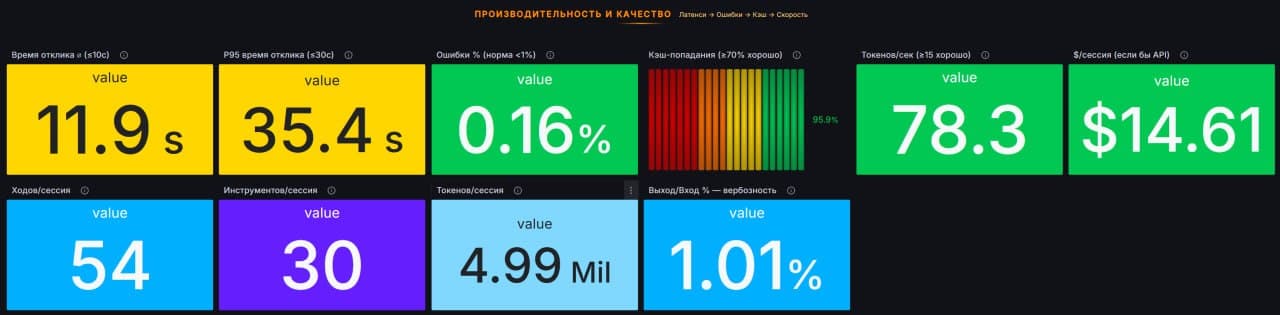
Performance & Quality

Monthly Totals

Session Summary
Grafana dashboard of agentic sessions · representative snapshot
Ready to discuss?
If you need an architect who builds autonomous AI systems — reach out.
Serbia-based · CET/CEST timezone · EU-aligned working hours · International contracts experience